Nebraska Medicine Help and FAQs
Role: Content strategy, UX writing, information architecture and AI optimization
Designing support content for people, search and AI
Nebraska Medicine did not have a centralized Help Center where patients could quickly find answers to common questions about billing, insurance, appointments, One Chart, the mobile app and virtual care.
I contributed to the content strategy and creation of a new Help Center designed around the questions patients actually ask. The goal was to make support information easier to find, understand and act on while also preparing the content for changing search behaviors and AI-generated answers.
The challenge
Important support information existed across the Nebraska Medicine website, but it was often organized according to internal departments, systems or processes rather than patient needs.
Someone with a billing question might not know which department owned the answer or what terminology to search. Patients needed a simpler way to find clear answers without navigating multiple pages or contacting support for every question.
The project required us to:
Create a new content structure that did not previously exist.
Organize complex operational information around patient questions.
Make answers easy to scan and understand.
Support traditional search, on-site search and AI-powered discovery.
Maintain accuracy across content involving billing, insurance and patient accounts.
The approach
We organized the Help Center around common patient tasks and areas of confusion rather than Nebraska Medicine’s internal structure.
The main Help Center directs users to topics such as One Chart, the mobile app, billing and insurance, appointments, virtual care and pharmacy. It also surfaces frequently asked questions so patients can move directly to high-demand answers.
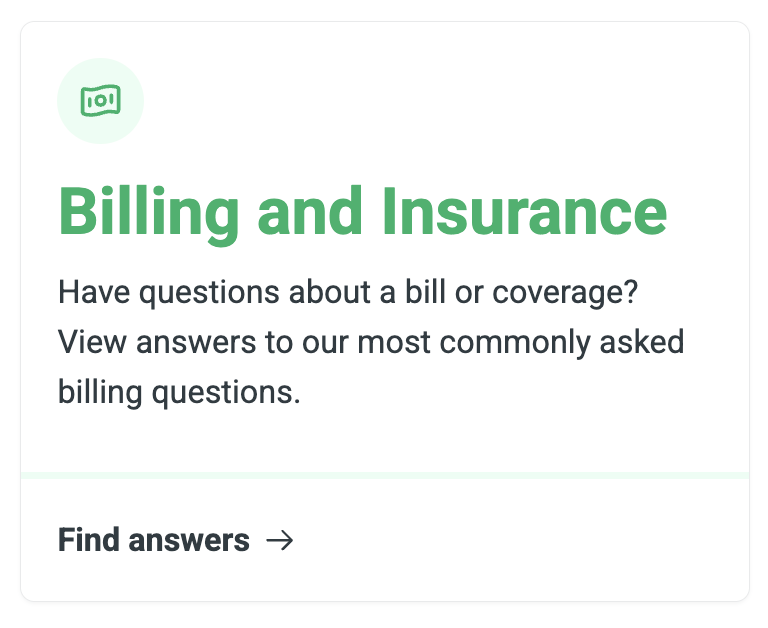
Within the billing and insurance section, questions are grouped into clear categories including understanding a bill, making a payment, insurance coverage, cost estimates, financial assistance and refunds.
This created a hub-and-spoke system that helps users begin with a broad need, narrow their question and reach a focused answer.
Writing for AI visibility
We considered AI optimization, or AIO, throughout the content process. Instead of treating the Help Center as a collection of traditional marketing pages, we structured it as a reliable source of direct, reusable answers.
Natural-language questions
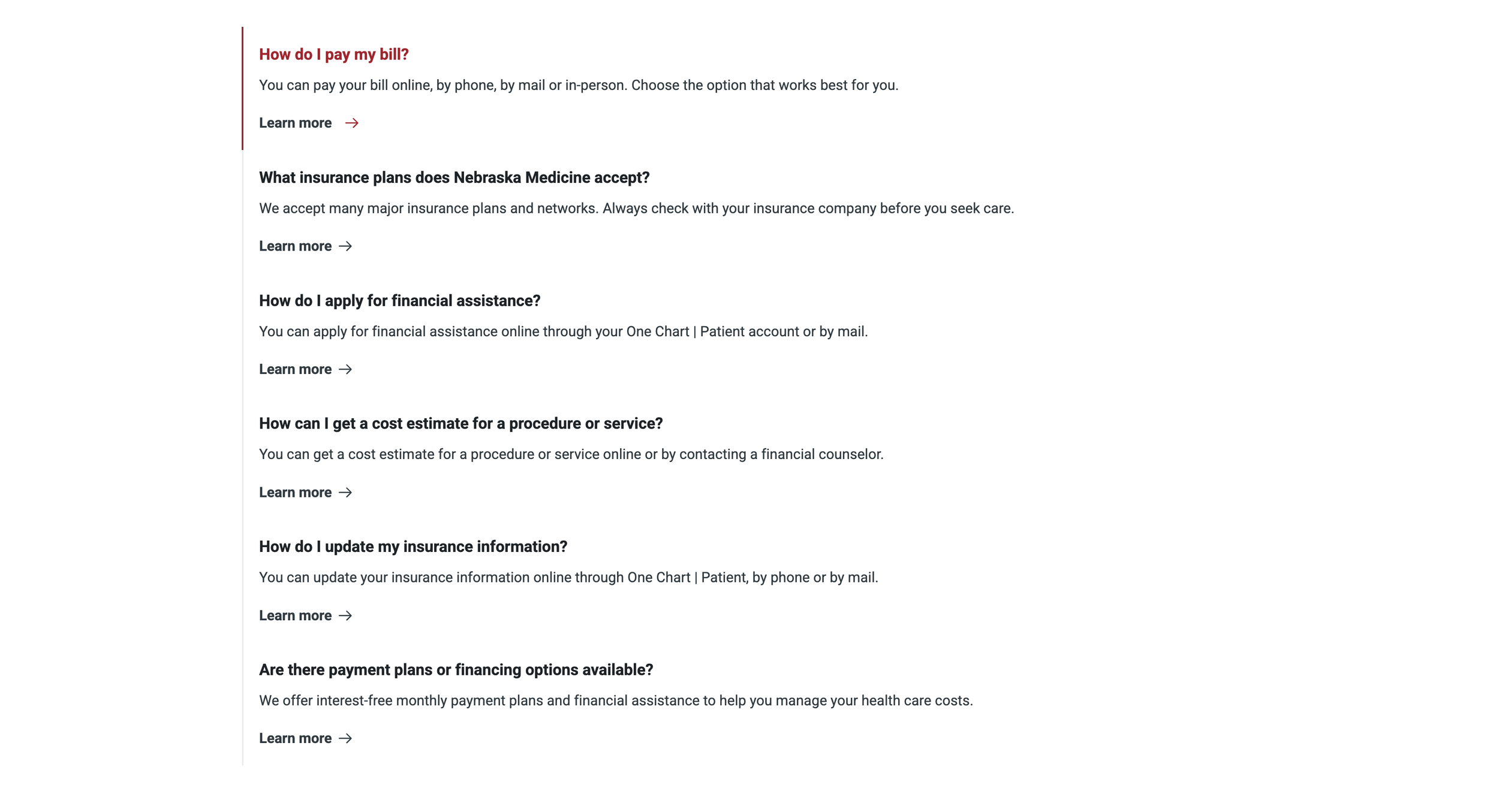
Headlines were written to reflect how patients are likely to ask for help, such as:
“How do I pay my bill?”
“How do I update my insurance information?”
“What is the difference between a bill and an Explanation of Benefits?”
“How can I get a cost estimate for a procedure or service?”
This improves the connection between the user’s question and the page that answers it. The live billing and insurance hub now presents dozens of these question-based pathways.
Direct, self-contained answers
Each answer was designed to address the primary question quickly before introducing supporting details, instructions or related resources. This helps patients scan the page and makes the content easier for search engines, site search tools and generative AI systems to interpret.
Clear information hierarchy
We separated broad topics from individual questions so each page could focus on a specific user intent. Consistent headings, summaries and internal links help establish the relationship between the Help Center, its topic hubs and individual answers.
Plain language and consistent terminology
We translated complex billing, insurance and health system processes into language patients could understand. We also used consistent names for tools and services, helping reduce ambiguity for both users and automated systems.
My contribution
I helped develop and write content for the new Help Center, including the billing and insurance experience.
My work included:
Identifying common patient questions and search intents.
Turning complex internal information into clear, patient-friendly answers.
Organizing related questions into logical categories.
Writing question-based titles and concise page summaries.
Applying AIO principles to make answers clear, focused and reusable.
Collaborating with subject matter experts to maintain accuracy.
Creating content within Nebraska Medicine’s existing website templates and content management system.
The result
The result was a new, centralized support experience that gives patients a clearer path to answers.
Instead of requiring users to understand Nebraska Medicine’s internal structure, the Help Center begins with their needs and questions. The content is useful in the immediate website experience while also creating a stronger foundation for on-site search, organic search and AI-generated discovery.
Portfolio card summary
I helped create Nebraska Medicine’s first centralized Help Center, organizing complex support information around the questions patients actually ask. I wrote clear, task-focused content and applied AI optimization principles to make answers easier for people, search engines and generative tools to find and understand.